
It’s that time of year again: the one that no one looks forward to, but that every adult living in France has to go through. The annual tax return. And as an expat, the French tax return comes with an extra layer of complexity.
I am not a tax expert. Only a professional tax advisor and the French tax authorities can provide adequate personal tax advice — including guidance on specific regimes such as the expatriate tax regime. What I can offer are practical pointers based on my own experience repatriating to France, combined with over 12 years of professional global mobility experience. This article does not replace the support of a tax advisor, but I hope it clarifies the essentials before you pick up the phone.
Before diving into the filing process, if you want to understand how French income tax is actually calculated and why the rates you see online are often misread, start here: How much tax do you really pay in France?
Table of Contents
Do Expats Have to File a French Tax Return?
The French tax return for a given year covers the income earned in the previous year. This means you do not need to file a tax return in the year of your arrival in France. You file the following year, for the income you earned during your year of arrival.
In that first filing year, you will also need to confirm whether you are a French tax resident or not. Start by consulting the tax treaty between France and your previous country of residence. If the treaty does not clarify your situation, apply the residency criteria in the section below.
One thing not to skip: request your French tax number (numéro fiscal) during your first year in France. Even if you do not need to file immediately, having it in advance will make everything significantly smoother when the time comes.

How to Get Your French Tax Number (Numéro Fiscal)
If this is your first time living in France, you will not yet be registered with the French tax office (impôts).
Your first step is to obtain your French tax number and set up your personal online space on impots.gouv.fr. To do this, the tax office requires identity verification. You will need to provide:
- Proof of your civil status (birth certificate or marriage certificate)
- A postal address in France
- A copy of a valid identity document
You can submit these either in person at your local public finance centre or by post.
Once your identity is verified, you will receive an email with your tax number and instructions to create your online personal space. You will set a password and validate your account via a link sent by email, valid for 24 hours.
Keep your tax number and password somewhere safe. You will need them every year.
Are You a French Tax Resident? How to Know
You are considered a tax resident in France if you meet one or more of the following criteria:
- Your household (spouse or civil partner and children) is based in France
- You carry out your principal professional activity in France, whether salaried or self-employed
- The centre of your economic interests is in France: your main investments, registered business, or the majority of your income
If none of these apply, you are not a French tax resident.
As a French tax resident, you must file a tax return declaring all income earned in France and abroad.
As a non-resident, you only need to file if you have income sourced in France.
How to File Your First French Tax Return Step by Step
Paper form or online?
For the very first procedure you carry out with the French tax administration, paper is still the required route. This applies whether you are adjusting your withholding rate, filing your first return, or requesting your numéro fiscal. Paper documents should be sent by post to your nearest tax centre or delivered in person.
Once your tax number is issued and your online account is active, you can handle all future procedures online via impots.gouv.fr. Paper remains an option if you prefer it, but online filing is faster and the system pre-fills some fields based on prior years.
Insider tip: since 2020, paper tax forms are no longer sent out by post automatically. Download the forms you need from the links below or file directly online once you have your tax number.
Which forms do you need?
If you are a non-resident with French-source income:
Fill out Form 2042, the main tax return form.
If you are a French tax resident:
Fill out Form 2042 (required for everyone), plus:
Form 2047: to declare income received abroad. All types of foreign income must be included, even if it is not ultimately taxable in France.
Form 3916: to declare any bank accounts held outside France. This includes current accounts, savings accounts, and digital accounts such as Revolut or Wise. The fine for failing to declare a foreign account is €1,500 per account.
Both forms 2047 and 3916 are accessible via the déclaration annexe tab when filing online.
Supporting documents to have ready
- Passport copy and residence permit for each family member
- Copy of your lease contract (if applicable)
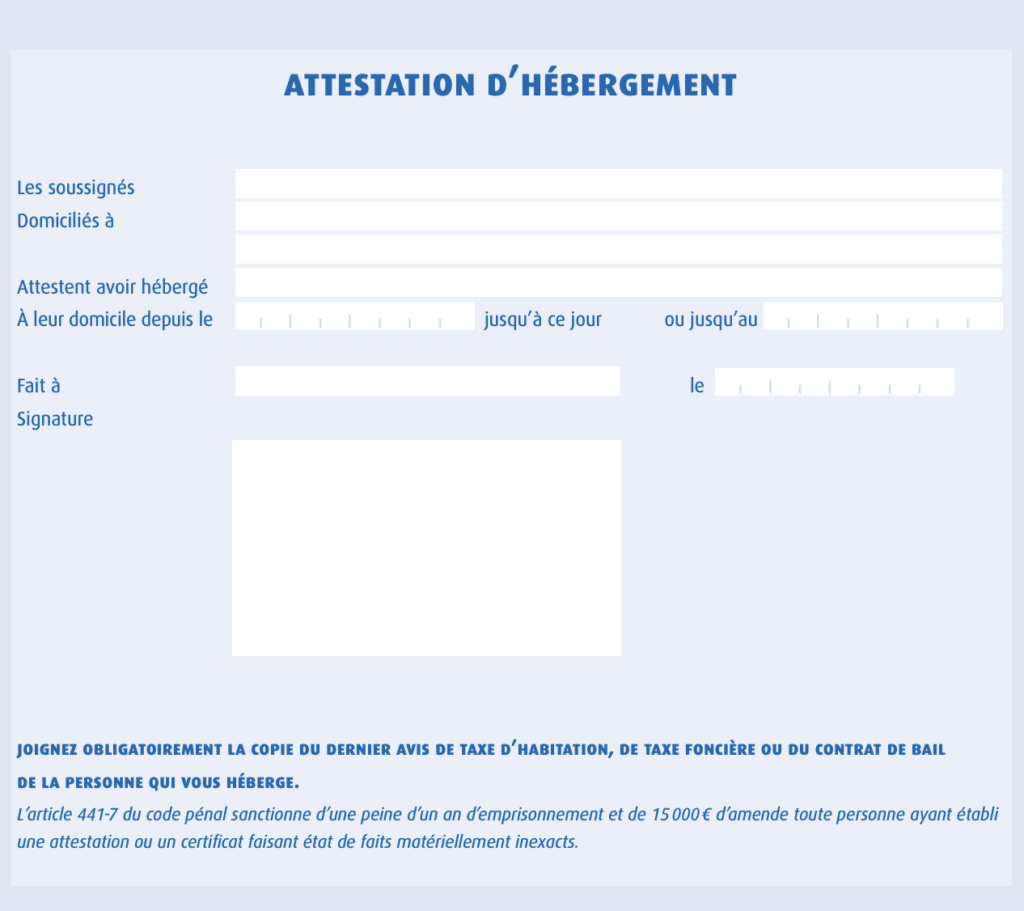
- Housing attestation if you are staying with someone (your host fills in the attestation d’hébergement section at the end of form 2042)
- Children’s birth certificates (if applicable)
- Marriage certificate (if applicable)
What Income Do Expats Need to Declare in France?
French income
Your taxable amount (montant imposable) appears at the bottom of your payslip. Your December payslip, or your last payslip of the year if you changed employer, will show your cumulative annual taxable figure. That is the number to declare. If you worked for multiple employers during the year, add up each annual taxable figure
Foreign income
If you are a French tax resident, you must also declare your foreign income using form 2047. The bilateral tax agreement between France and your home country will determine the conditions under which double taxation is avoided.
Only foreign income earned after your arrival date in France should be declared. Income earned abroad before you became a French tax resident does not go on your French return.
For a full explanation of how income tax is calculated in France, including the brackets, the household system, and how social charges differ from income tax, read my detailed guide: How much tax do you really pay in France?
How Much Will I Be Taxed?
This is a question best answered by a qualified tax advisor, who can assess your specific situation and confirm the French income tax rates applicable to you. But I can walk you through how the calculation works in practice, using a concrete example. Keep in mind this is a simplified illustration — other elements covered in this article will also affect your final tax bill.
Example: the Smith family (2026 figures)
Mr and Mrs Smith are married with two dependent children. Each has a net taxable income of €30,000, giving a household total of €60,000.
Each adult counts as one part, and each of the first two children adds half a part, giving the household three parts in total (the quotient familial).
Both spouses benefit from the automatic 10% professional expenses deduction on their salary income, bringing the household’s net taxable income to €54,000 (€60,000 minus 10%).
Dividing by three parts: €54,000 ÷ 3 = €18,000 per part.
Applying the 2026 brackets to each part:
- Up to €11,600: taxed at 0% → €0
- €11,601 to €18,000: taxed at 11% → approximately €704
Tax per part: €704. Multiplied by three parts: total household income tax approximately €2,112.
On a gross household income of €60,000, that is an effective rate of around 3.5%.
This illustrates two things: how the progressive tax scale works in practice, and how significantly the household income-splitting system reduces the tax burden for couples with children compared to what the headline rates suggest.
For a full breakdown of the French income tax brackets, the difference between marginal and effective rates, and how social charges fit into the picture, read the dedicated guide: How much tax do you really pay in France?
Double Taxation Agreements: How to Avoid Paying Tax Twice
To avoid double taxation, check the bilateral tax agreement between France and your previous country of residence. You can find the full list of bilateral tax conventions signed by France on impots.gouv.fr. The tax authority in your home country may also publish the treaty in your language, which can make it easier to understand.
If you need the treaty applied to your situation, send a request to the French tax office including:
- A written request letter
- A copy of the relevant tax treaty
- Proof of your professional activity in France (employment contract and work permit if applicable)
Important: if a tax exemption under a bilateral agreement applies to your situation but the exemption period is shorter than your total time in France, the exemption will not cover your full stay. Check this carefully with a tax advisor.
How to Set Your Personalised Tax Withholding Rate in France
Since 2019, France collects income tax at source through a system called prélèvement à la source. When you start employment in France without a prior tax history, a neutral withholding rate is applied by default. This neutral rate is calculated as if you were a single person with no dependants, which means it is often higher than your actual rate.
To avoid overpaying throughout the year (and waiting until the end of the year for a refund), you can request a personalised rate. There are two ways to do this:
Online: Log into your personal space on impots.gouv.fr, go to Gérer mon prélèvement à la source, and update your information directly. This is the fastest method.
By paper: Fill out Form 2043-SD and submit it with the following documents:
- Passport copy for each family member
- Visa copy for each family member (if applicable)
- Marriage certificate (if applicable)
- Children’s birth certificates (if applicable)
Once processed, your personalised rate will be communicated to your employer, who will apply it from the following payroll cycle.

French Tax Return Deadlines: Key Dates to Know for 2026
Filing deadlines
The 2026 tax return covers income earned in 2025. Online filing opened on April 9, 2026. Deadlines vary by department of residence.
Source: service-public.gouv.fr, confirmed April 2026.
| Department | Online filing deadline |
|---|---|
| 01 to 19 (and non-residents) | Thursday May 21, 2026 at 23:59 |
| 20 to 54 (including Corsica) | Thursday May 28, 2026 at 23:59 |
| 55 to 974/976 | Thursday June 4, 2026 at 23:59 |
For French residents abroad: the deadline is Tuesday May 19, 2026 at 23:59.
If you are filing on paper, deadlines are earlier than the online dates. Check impots.gouv.fr for the exact paper deadline applicable to your department.
Tax notice
Your avis d’impôt (tax assessment notice) is sent at the end of August or beginning of September. Keep it safely: you will need it for other French administrative procedures, including CAF (family allowance) applications and rental files.
French tax notice
Your tax notice is sent at the end of August or the beginning of September, as a back-from-holiday present!
In Summary
The French tax system has its own logic, and the first few years are the most disorienting. The most common mistakes expats make are failing to declare foreign accounts, missing the deadline in the year after arrival, or applying the wrong withholding rate from the start.
None of this replaces the advice of a qualified French tax advisor, particularly if your situation involves foreign income, investments, or complex family arrangements. But knowing the basics before that conversation will save you time and money.
Keep your tax returns on file. You will need them for CAF aid requests, rental applications, and other administrative procedures throughout your life in France.
Bonne chance, et merci et à bientôt.
Ready to get the full roadmap for your move to France, from visa to arrival admin to settling in?


2 Comments
Annabelle Muff
Hey could you please give contact on someone who’s able to fill out everything for me? Since it’s all in French.
Mademoiselle Guiga
Hello Annabelle,
Please contact me on my email: [email protected].
I’ll be able to give you some contacts.
best,