Looking for a long-term rental in France is not an easy task, especially when you come from another country. To help in your research, here are some insider tips from someone who has been through it!
If you have searched for housing before, you know that finding the accommodation of your dreams does not happen overnight. Between reviewing multiple websites, lowering your standards, and visiting different types of housing, it is difficult to find the perfect place.
It takes most people about two to three weeks to find a rental apartment. You can reduce your home search time by asking yourself the right questions first: Furnished or unfurnished? Shared flat or own apartment? Is my budget charges included or rent only? Take the time to prepare, and you will get a clearer idea of your needs.
Table of Contents
Best websites to find a long-term rental in France
This is the most common question from expats starting their search. Here are the main platforms to use simultaneously — the French rental market moves fast, especially in big cities.
| Website | What you need to know |
| LeBonCoin (leboncoin.fr) | The French equivalent of Gumtree or Craigslist. Huge volume of listings — mix of private landlords and agencies. Watch out for ads that look too good to be true. They probably are. |
| SeLoger (seloger.com) | One of France’s biggest real estate portals. Mostly agency listings — reliable and high quality, but agency fees apply on top of the rent. |
| PAP (pap.fr) | De Particulier à Particulier — private landlords only, no agency fees. Very popular in Paris, less used elsewhere. You may need to pay a small fee to access contact details for some listings. |
| FUSAC (fusac.fr) | English-language community magazine focused on Paris. The housing section is free to browse — no membership needed. A good starting point for English-speaking expats. |
| Facebook groups | Search for expat groups in your target city. Private landlords sometimes post there before listing on the main platforms. Also useful for getting recommendations from people who’ve been through the search recently. |
⚠ Scam alert
Never pay a deposit or sign a rental contract without visiting the property in person first. If you cannot visit before arrival, book a short-term Airbnb or hotel for 2–3 weeks while you search.
Tip 1: Set your budget and needs
Your housing budget according to rental agencies
Rental prices vary a lot depending on where you are looking. Real estate agencies generally apply an unwritten rule: the rent should not exceed 1/3 of the tenant’s income. So if you search via an agency, this pretty much sets your budget and the type of accommodation you can afford in a given location.
This surprises many expats. It is common to spend a higher portion of income on accommodation in other countries. However, French real estate law strongly protects tenants, which makes it very hard for a landlord to evict a non-paying tenant. Agencies and landlords want to make sure the rent will always be paid.
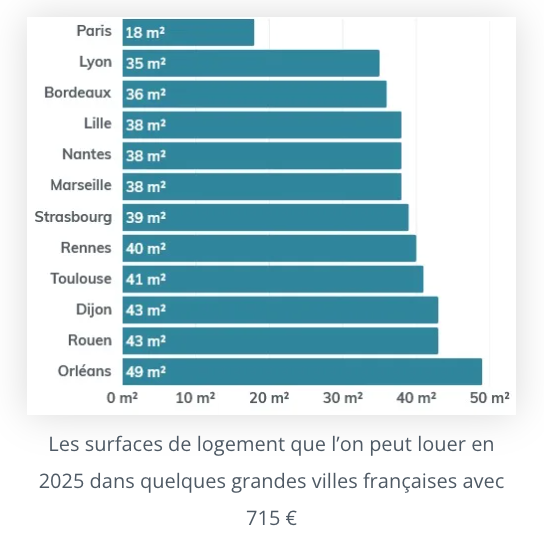
According to LocService’s 2025 data (the most recent complete year available), with a €715 monthly budget, here is the approximate property size you could get in the main French cities:
Rental prices also differ depending on furnished vs unfurnished. Furnished accommodation is usually 20% more expensive than equivalent unfurnished.
Planning to move to the South of France?
Rental prices in cities like Nice, Marseille, and Montpellier are significantly lower than Paris but have been rising steadily. The South of France market moves quickly in spring and summer due to seasonal demand. If you are targeting this region, start your search at least 2 months in advance and expect higher competition for properties close to the coast.
The hidden costs
In addition to the actual rent, budget for the following:
- Moving costs
- Real estate agency fees: usually around one month’s rent
- Security deposit: one month’s rent excluding charges (can be more for furnished accommodation)
- Rental insurance (compulsory in France): annual fee from €160 to €500 depending on the region and type of property. See: Compulsory insurance in France
- Fees to set up utilities:
| Utility | Cost (incl. VAT) | Timeline |
| Water | €30–€60 (region and provider) | Varies |
| Electricity — Standard service | €30.37 | 5 business days |
| Electricity — Express service | €71.40 | 2 business days |
| Electricity — Emergency service | €141.92 | Within 24h (request before 3pm) |
| Internet activation | ~€50 | 5–10 business days on average |
Source: EDF official tariffs 2025. Gas setup fees follow a similar structure — check your provider’s website for current rates as these are updated periodically.
Housing tax (taxe d’habitation) — 2023 update
The taxe d’habitation on primary residences has been fully abolished since 1 January 2023 for all taxpayers in France. If you are renting as your main home, you will not receive a housing tax notice.
The tax still applies to secondary residences and vacant properties. If you own or rent a property that is not your primary residence, you remain liable. The amount depends on the property type, location, and your income.
The visa is one step. Housing, admin, and healthcare are the rest. France Formula covers the full move — not just the paperwork. Join the waitlist below.
Tip 2: Understand the ads
Coded terms
French rentals are classified by size and coded as follows: T (type) is for apartments and F (foncier) is for houses. The number indicates the number of rooms including the living space (but not the kitchen, bathroom, or toilet).
For example:
- T2 Bis = T2 with an alcove — a double room or small extra space (common in Lyon’s older buildings)
- T2 = one-bedroom apartment (one living room + one bedroom)
- F3 = house with two bedrooms (one living room + two bedrooms)
⚠ CAUTION: The F category is often misused. Many one-bedroom apartments are listed as F2 instead of T2. Don’t rely on the letter alone — always check the floor plan.
Common abbreviations in rental ads
- Asc: Ascenseur (lift)
- Chb: Chambre (bedroom)
- CC: Charges comprises (monthly housing fees included)
- Chauff: Chauffage (heating)
- Sbd: Salle de bain (bathroom). Salle d’eau means there is no bathtub and only a shower
- RDC: Rez de Chaussée (ground floor)
Tip 3: Prepare your rental file
Whether you use an agency or not, you will need to prepare a rental file (dossier) to apply for properties. Prepare it in advance and bring it to your first visit — especially in big cities where competition is fierce.
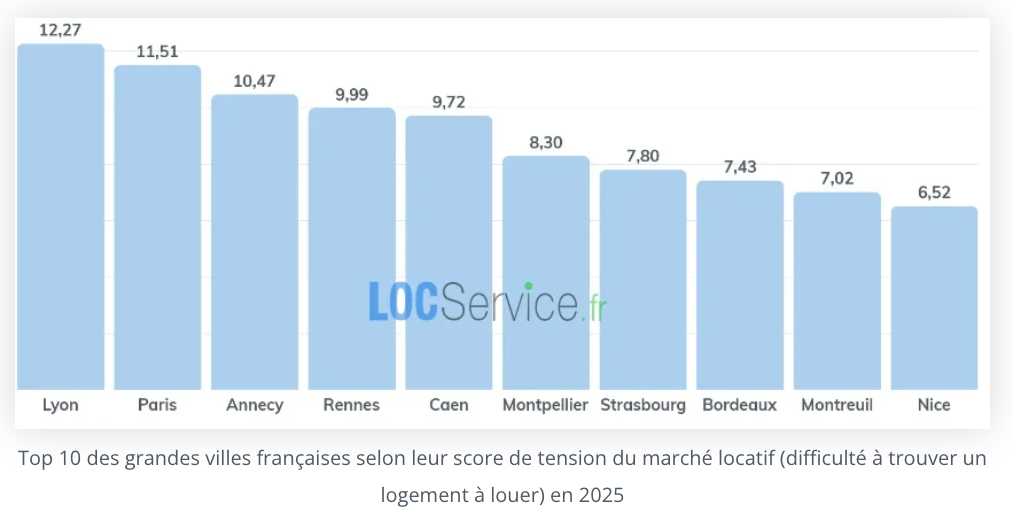
Top 10 Number of housing requests per rental offer in 2025
The following documents are typically requested:
- Proof of identity
- Proof of earnings and employment status (work contract, last 3 payslips, previous year’s tax filings)
- Proof of sufficient resources
- Proof of current address
- Copy of your RIB (French bank account details). Some landlords may ask for a larger deposit if you don’t yet have a French bank account
Tip 4: How to find your long-term rental in France?
Book temporary housing first
Many expats find it difficult to secure a place before arriving in France. It is also much safer to visit a property before committing to renting it. Renting an Airbnb or hotel for a few weeks while you search is very common. Book with an extension option in case your search takes longer than expected.
Beyond the websites listed above, also consider:
- Your network: tell everyone you are looking. The best deals in France are often found through word of mouth — colleagues, acquaintances, Facebook expat groups
- Real estate agencies: more expensive due to fees, but agents can speed up the search significantly
- University bulletin boards: if you are coming to study, your institution may have a housing board with private listings
Tip 5: How to find a long-term rental in France without a guarantor?
Why a guarantor is needed?
A guarantor (garant) is someone who agrees to pay the rent on your behalf should you ever miss a payment. Because French law strongly protects tenants and makes eviction very difficult, agencies and owners use the guarantor as an extra layer of security.
Most agencies prefer a guarantor living in France, though some may accept one living abroad, mainly within the EU. Not having a guarantor is often the biggest challenge for an expat.
Ask around you
If you do not know anyone who could be your guarantor, consider asking your employer. Companies cannot act as guarantors as legal entities, but your manager might agree personally — the sooner you find a place, the sooner you are fully focused on the job.
Convince the landlord to take ”unpaid rent insurance”
This specific insurance for landlords covers unpaid rent. When a landlord has this insurance, they are legally forbidden from also requesting a guarantor. The insurance is often more reliable than chasing a guarantor — a strong argument to make.
Get a guarantor via the VISALE system
VISALE (Visa pour le Logement et l’Emploi) is a free government-backed guarantee scheme. It applies under the following conditions:
- Anyone under the age of 31
- Professional workers above the age of 31, within the first 6 months of a new work contract
- The guarantee applies only to mobility rental contracts (bail mobilité) — specific contracts for furnished rentals under 10 months duration
You can apply directly and for free at visale.fr.
Long-term rental in France FAQ
How do I find a long-term rental in France?
The two biggest websites are leboncoin.fr and seloger.com. Use both simultaneously, and complement with pap.fr for private landlords. Also scan your target area for “A Louer” signs and check local Facebook expat groups for off-market listings.
Can I rent in France without a guarantor
Yes, it is legally possible — but most agencies will ask for one. Some owners rent without a guarantor. Alternatives include the VISALE scheme (for eligible profiles) and landlords with unpaid rent insurance.
What is VISALE?
VISALE is a free government guarantee scheme for tenants under 31, or professionals within their first 6 months of a new contract. The guarantee applies only to mobility rental leases (bail mobilité). Apply at visale.fr.
What are the documents requested for the rental application file in France?
Standard documents: proof of ID, proof of earnings or sufficient resources, proof of employment (if applicable), proof of current address, and your RIB (bank details). Some additional documents may be requested, but certain documents are illegal to request in France, including criminal records and medical information.